



Stanway House is a historic Jacobean manor house situated in the village of Stanway, Gloucestershire, England, nestled within the Cotswolds. It is known for its 18th-century water garden, featuring a striking single-jet fountain, as well as its honey-colored Guiting stone architecture, beautifully preserved Elizabethan and Stuart features, and a lived-in charm that sets it apart from more formal stately homes. Many of our self-guided walking tours and guided walking tours of the Cotswolds feature this classic Cotswolds attraction.
The House
Stanway House is one of the Cotswolds’ best-known historic houses, offering visitors a glimpse into the history of the United Kingdom. The house itself is worth visiting but not if you are expecting a series of museum-like pristine rooms with roped-off exhibits. It is obviously lived in and all the better for it. There are, however, visitor information cards distributed here and there about the house.
The great hall is extraordinarily light and airy, having an enormous full-height bay window and further bays at the south end. Manorial courts were held here up until about 1800, and the raised dais at one end is still in place.
The south front is from the Stuart period and contains all the principal rooms. A short flight of stairs leads from the hall into the drawing-room, in which are a pair of unique ‘Chinese Chippendale’ day beds from about 1760, which came from the Wemyss seat at Amisfield House in East Lothian, Scotland.
Further along is the ‘Elcho’ Lobby, followed by ascending stairs to the library passage from which an oak staircase leads to the upper storey. Off the passage is the old library, which has only one window and is the warmest room in the house in the winter. At the end of the passage is the ‘Elcho’ sitting room, very comfortable and lived in. The other wings have been demolished, leaving the house with an ‘L’ plan.
Conclude your visit with a quintessentially English afternoon tea in the Tea Room. Expect cream teas, locally-made ice cream, and homemade cakes to perfectly round out your experience.
The Water Garden
Behind the house itself is a garden that slopes up to a lake or ornamental canal. From the lake, at certain hours on opening days, water is forced up to a height of over three hundred feet, an impressive feature in a rediscovered 18th-century water garden. It turns out to be the tallest fountain of any kind in Britain, the second tallest fountain in Europe, after the 400-foot-high turbine-driven fountain in Lake Geneva, and, extraordinarily, the tallest gravity-fed fountain in the world.
Above the lake is a pyramid built by Robert Tracy in 1750 honouring his father, John Tracy, who died in 1735. A cascade, which has been restored over the last few years, runs from here to the canal.
The Grounds
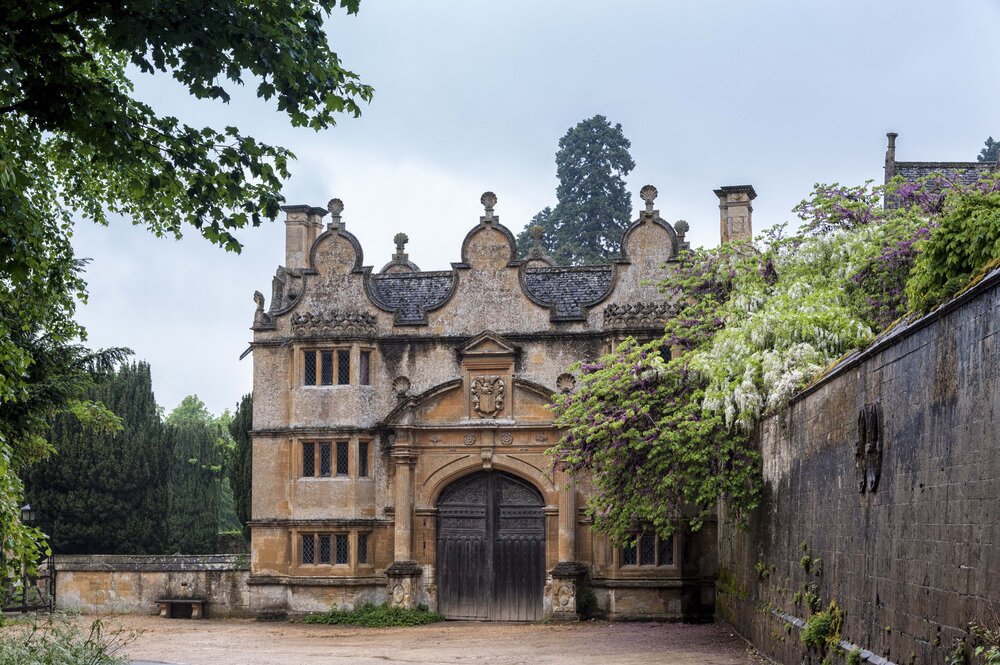
One of the first things you see, if you enter from the Cotswold village of Winchcombe direction, is the gatehouse. Built of local Guiting Yellow stone, a rich, honeycomb amber, it is a brilliant Jacobean doodle-made material, probably crafted by a local stone mason, Timothy Strong. In silhouette at the top is a row of scallop shells, which, as well as being associated with the pilgrimage to Santiago de Compostela, were part of the Tracy family crest. It is surely one of the most arresting and most beautiful buildings in the Cotswolds. It occupies an eccentric position at right angles to the house, rather than in front of it, presumably because the proximity of the church meant that there was no other place for it. Or, should a more fanciful reason be preferred, once its beauty was understood, it was decided that it should be allowed to flower in its own right, not act as a mere conduit to the more sober elegance of the house itself. At any event, it stands almost in line with an avenue of trees in the pastures on the other side of the gardens, which may also have served as an entrance. Whether out of practicality or something more elevated, the result is that it has a wonderful life of its own, in keeping with the welcoming aspect of the house.
Immediately adjacent to the gatehouse is Stanway Church, from the grounds of which, over the wall, beside a doorway, is a view of the house, with its magnificent oriel window. The house is built of the same mellow stone as the gatehouse, a long, elegant, almost homely Elizabethan facade beneath a typical Cotswold stone roof. Even the churchyard is a jumble of peculiar detail, the detritus of centuries. Beneath the entrance gate is a pair of half millstones, whilst the churchyard wall to the north has an ancient stone coffin built into it. The main interest of the church itself is on the southern wall of the older, eastern section, decorated with a row of perfectly formed and surprisingly benign gargoyles.
As you stand at the entrance, the ancient tithe barn is to your right. This was built in about 1370 for Tewkesbury Abbey and restored in 1927 by the architect Sir Philip Stott for the Earl of Wemyss. It is a building of accidental beauty – built to house the ‘tithes’ owed by tenants to the then-owners of the land, the abbots of Tewkesbury, it is constructed of coursed rubble masonry, with a gloriously undulating stone slate roof. Inside, there are seven bays, and overhead, a series of impressively massive rafters.
Ahead of you, just to the left of the house, is the brewery, which, after many years of idleness, has been revived. Integrated into the brewhouse are two coppers built over log fires – Stanway is one of only two log-fired breweries in the country. The open cooler is still present, although used only for storage now; the rest of the equipment is newly installed. Several beers are brewed, including ‘Stanney Bitter’ and the ‘Lords a Leaping’, which are available in a handful of local pubs including the Pheasant Arms at nearby Toddington, the White Hart in Winchcombe, the Volunteer in Chipping Campden, the Hewlett Arms in Charlton Kings, the Gardeners Arms in Alderton and in Broadway, the Dormy House Hotel and the Crown & Trumpet.
Outside the grounds, just off the road leading up from the gatehouse towards the Stow-on-the-Wold road, is the old Estate watermill, now restored to full working condition. Powered by a twenty-four-foot diameter waterwheel, it produces wholemeal and sifted flour from wheat grown on Stanway Estate. Beyond it is a working blacksmith, and a short walk from here is the Old Bakehouse Tearoom, where you can take tea and excellent homemade cakes in a pretty garden.
Peter Pan and Cricket at Stanway House
Walking from the gatehouse along the road, passing the church, you round a corner, pass the tennis courts on the left, and come to the public entrance to the house on the right. Across to the left is the cricket pitch, with a thatched pavilion, which has a connection with the creator of Peter Pan, J.M. Barrie.
After the First World War, Barrie, who loved cricket, was a regular guest at Stanway House and paid for the pavilion. In fact, Barrie founded an amateur cricket team, the Allahakbarries, for his friends. Among the sometimes players were Arthur Conan Doyle, H.G. Wells, Jerome K. Jerome, G. K. Chesterton, A. A. Milne, and P. G. Wodehouse.
Timber-framed and clad with larch poles, the pavilion is raised on twenty-five staddle stones (staddle stones are mushroom-shaped ‘feet’, used in the past to protect granaries and other similarly vulnerable buildings from vermin – mostly used now as garden decorations).
If a visit to this much-loved manor house is on your itinerary while you’re in the Cotswolds, keep in mind the opening times. Stanway House is open on Tuesdays and Thursdays in June, July and August from 2 pm until 5 pm.
A visit to Stanway House offers far more than a glimpse into the past — it’s a step into a living story of English heritage, charm, and eccentric beauty. From the soaring fountain and tranquil water gardens to the honey-stone architecture and fascinating literary connections, every corner of the estate feels steeped in history yet warmly welcoming. Whether you linger over afternoon tea, sample a log-fired brew, or simply wander the grounds in quiet admiration, Stanway House is a place that leaves you with lasting memories of the Cotswolds at its most enchanting.